

Huddling penguins make waves in the Antarctic winter

Original article: Coordinated Movements Prevent Jamming in an Emperor Penguin Huddle

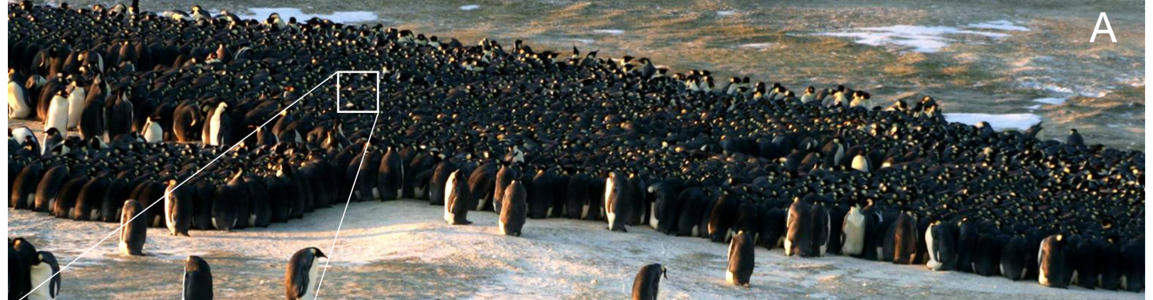
Standing in the center of a crowded bus on your way to class, you might think: “why don’t these people just move? It’s hot and I can’t breathe!” Male penguins huddling to keep their eggs warm in the Antarctic winter have the opposite problem – no penguin wants to be at the cold edge of the huddle. A penguin in the huddle wants to stay in the warm center, since the outside temperature can reach -45 oC. However, penguins on the edge of the huddle are trying to push through the crowd to reach the center. Through the independent motion of each penguin, the huddle stays tight enough for the center to remain warm but loose enough to keep moving.

In today’s study, Zitterbart and colleagues investigate how huddling Emperor penguins can keep moving, as in this video.  They find that individuals take small, coordinated steps that reorganize the huddle on a time scale of hours.

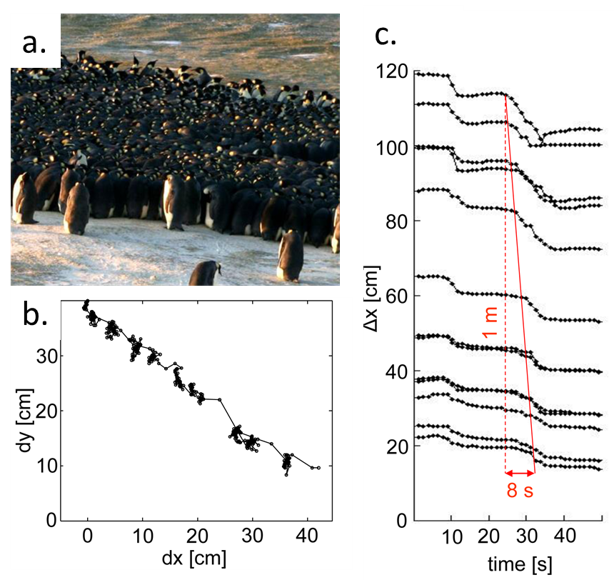
Zitterbard and colleagues film a 2000-penguin colony (shown in Figure 1a) for 4 hours and track the positions of the penguins, with an x-coordinate corresponding to horizontal position on the camera image and  y-coordinate corresponding to the vertical position on the camera image. When huddling, the penguins all face in the same direction and are arranged roughly in a hexagonal grid. Every 30 to 60 seconds, the penguins take small steps, 5-10 cm long. Figure 1b shows the track of one penguin, with a point every 1.3 seconds. There are clusters of points where the penguin is standing still (with no significant change in position), and then a straight line when the penguin takes a step.

Since penguins at one spot in the huddle don’t know that another part of the huddle is moving, they don’t all step at once. Instead, there is a wave of moving penguins that moves through the huddle at a speed of 12 cm/s, like a sound wave traveling through a material. Figure 1c shows the tracks of several penguins at the same y-position and different x-positions in the huddle. Their horizontal motion is correlated – the penguin at the top track moves first, and then the motion propagates to the neighboring penguins as a wave. 

Figure 1. a. A photograph of huddling penguins with x- and y- coordinate axes. b. A track of a single penguin with points every 1.3 seconds. Clusters of points mean the penguin isn’t moving, and a straight line means the penguin took a step. c. Horizontal motion of several penguins. These penguins are at the same vertical position in the huddle but different horizontal positions. The slope represents the 12 cm/s motion of the wave of moving penguins.

An unusual aspect of this study is that the results section is short – the authors only report the traveling wave of penguins through the huddle. However, they then move to an explanation of penguin motion using very interesting  analogies to granular materials (such as sand or coffee beans). 

There are three effects of the small steps:

  1. They allow the penguins to reach the best density for warmth.
  2. They move the entire huddle forward, and merge small huddles into big ones.
  3. They reorganize the huddle, allowing penguins to leave the huddle at the front and join it at the back.

The combination of small penguin movements and organized huddling is similar to the way colloids [1] solidify when the particles in the colloid attract one another. Penguins huddle when they are “attracted” to each other by cold temperatures; colloids are attracted by electrostatic or intermolecular van der Waals forces. Thinking of a group of organisms as a fluid, such as smoothly flowing fish schools and turbulent bacteria, is a well known method for understanding their behavior. In contrast, the small steps in a dense group of penguins is reminiscent of a material going from a fluid to a solid state. The waves in the huddle are similar to waves in other groups of animals, like human crowds rushing to escape a room. Luckily, the penguin waves do not result in injury. (Usually.)

Through small, careful steps, penguins are able to create a solid cluster of warmth in the Antarctic winter. If we took a hint from the penguins and were more careful about our motion when on a crowded subway, maybe our commutes would be much more pleasant experiences. Of course, the huddling penguins are not bounded by the walls of a bus – how they would move if they didn’t have an open boundary is still a mystery!


[1] Mixtures of small particles dispersed throughout another substance, such as the fat suspended in a water solution to form milk.

Baromorphs: Shape Shifting by Inflating

Original paper: Bio-inspired pneumatic shape-morphing elastomers


Conventional robots typically move by moving rigid pieces relative to one another — think of a robotic hand where rigid bars rotate at joints. In other words, conventional robots have a small number of “degrees of freedom” — the angle of bending of the joint of a robot hand would be one degree of freedom, for example.  Soft robots, on the other hand, have many degrees of freedom: they can bend and deform into lots of different configurations. Because of this, they often display continuum-like behaviour, similar to what is seen in the movement of natural organisms such as worms and octopuses. These robots offer great promise in many fields, from soft instruments for minimally invasive surgery to shape changing airfoils for increased flight control. One of the particularly difficult challenges in soft robotics is to design systems that are flat at rest but can rapidly transform to an arbitrary three dimensional shape when activated. Recently, Emmanuel Siéfert and co-workers developed baromorphs— thin, flexible sheets which can be air inflated (“pneumatically activated”) into a pre-programmed target shape.

The researchers were inspired by what they saw in nature, where there are many examples of thin, sheet-like objects, such as flower petals, which grow into intricate curved shapes.  They do this by growing faster in some areas than others – this results in the petal curving in three dimensions. When biological growth is not an option, as in man made materials, the problem is difficult since thin, flexible sheets can only change shape by bending; they cannot stretch, as this is energetically unfavourable [1]. This places a strong restriction on the shapes that they can be morphed into. Researchers have previously approached this problem by swelling highly absorbent gels in a hot bath water; specifically, by controlling where the swelling occurs, they mimicked non-uniform growth seen in nature. Whilst promising, the time taken for the shape to change was limited by how quickly water can move from high to low concentrations—this is typically very slow—and, furthermore, the resulting structures were typically too soft to sustain their own weight. Pneumatically activated structures, on the other hand, depend only on the air flowing through them, and so can be made into a much wider variety of shapes.

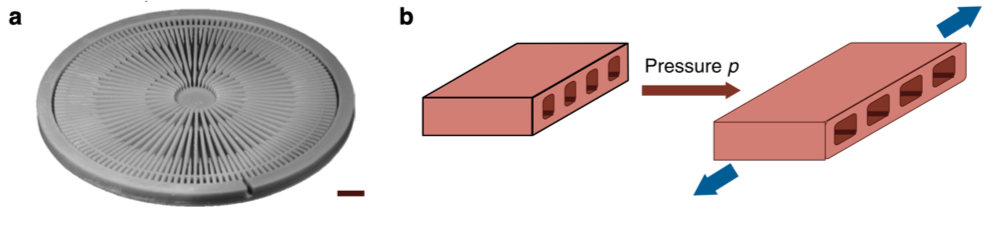
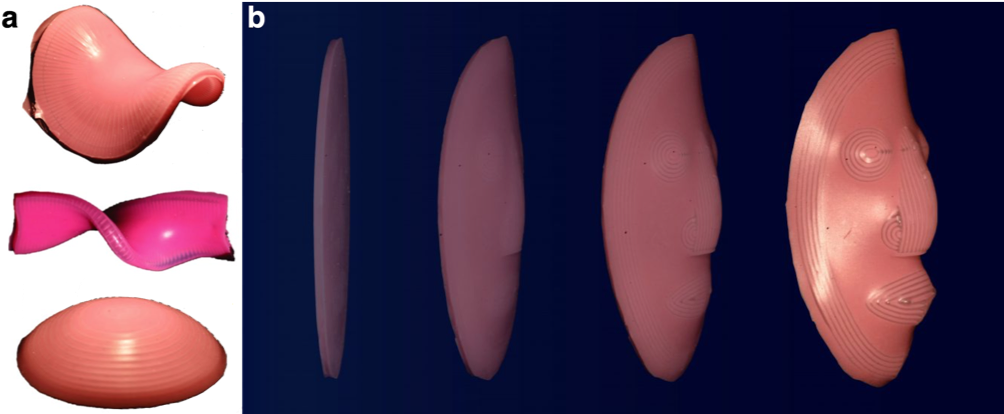
Figure 1. (a) Mould used for producing baromorphs with radial air channels. (Scale bar: 1cm) (b) Inflating the baromorph (applying pressure to the channel walls) causes expansion in the transverse direction (indicated by blue arrows). (Figure adapted from original article).

The researchers produced pneumatically activated baromorphs by setting two identical thin, rubber pieces in 3D printed moulds containing cavities for air to flow (Figure 1a) and then sticking the two pieces together. The process leaves an embedded network of channels through which air can flow (Figure 1b). Inflating the channels applies pressure to the channel walls, inducing a stretch along the width of the channels but not along their length (blue arrows in Figure 1b). Depending on the arrangement of the tubes, inflation can create excess length in the structure which is incompatible with a flat shape, forcing the structure to buckle out of plane. This creation of excess length is analogous to the inhomogeneous growth that leads flower petals to curve.
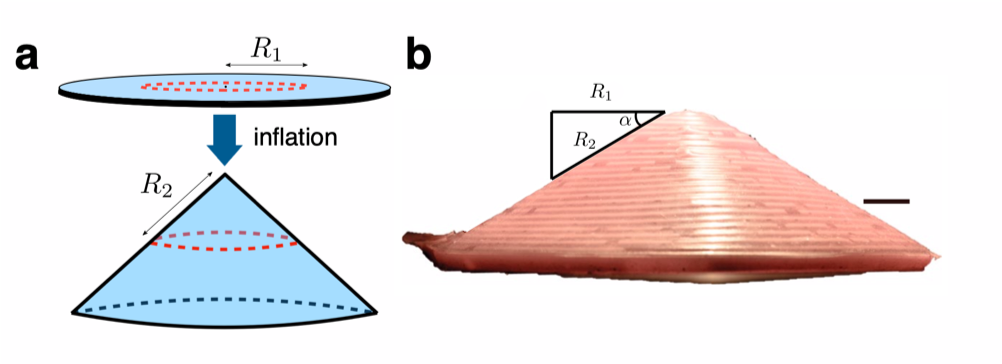
The effect is demonstrated by Siéfert et al. with an initially flat, circular baromorph containing circular channels. For this geometry, the excess length, created by inflation, stretches  a channel of radius of radius $latex R_1$ to a radius $latex R_2>R_1$ (Figure 2a). This causes the baromorph to buckle out of plane and form a cone, whose apex, $latex \alpha$, satisfies $latex cos(\alpha)=R_1/R_2$ (Figure 2b). Moreover, by solving the equations of linear elasticity, the angle can be predicted as a function of the applied pressure.

Figure 2. (a) Schematic diagram of inflation of a baromorph with constant radius channels. Inflating this baromorph forces a circular channel with radius $latex R_1$ to stretch to radius $latex R_2$. Buckling into a cone shape relaxes this excess length. (b) The conical baromorph used as a demonstration by Siéfert et al. (Scale bar: 1cm)

Whilst inflating into a shape is not new, it has so far been limited to  movements which deform every part of the shape in the same way, e.g. bending, twisting, and expansion. And, since baromorphs are activated pneumatically, the time taken to transform from the two dimensional (flat) configuration to the three dimensional one is limited only by the air flow through the channels. In other words, they can change state very quickly; the researchers demonstrated this by oscillating a conical baromorph at a frequency of 2 Hz (see video). Further, the structures aren’t size limited; they can easily be made to support their own weight by simply increasing the inflation pressure. 

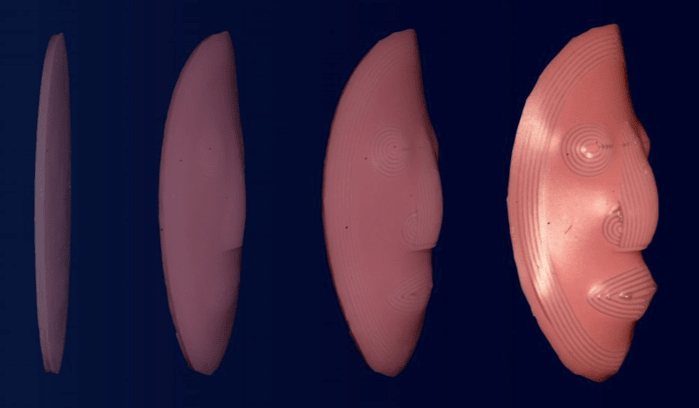
The key advantage of baromorphs over other pneumatically activated shape-morphers is their ability to take a wide variety of shapes obtained by simply tailoring the orientation and size of air channels in the network. For instance, baromorphs can be made into spherical caps, saddles, and helicoids (Figure 3a). This leads to the question: given a three dimensional target shape, how should the channel network be chosen? The team have derived a simulation which predicts which embedded channel structure should be chosen for a given target shape. The accuracy of this simulation is demonstrated by producing a baromorph that inflates into a face (Figure 3b).

Overall, baromorphs are an exciting prospect for future applications: they’re easy to produce; they can take virtually any pre-programmed shape [2]; and they can be inflated very quickly. The authors hope their work will allow other researchers to use shape-shifting materials in flow-optimization — tailoring the shape of air channels to maximise flow — as well as minimally invasive surgery.

Figure 3. (a) examples of inflated baromorph shapes: saddle, helicoid and spherical Cap. (b) Stepwise inflation of a face-shaped baromorph.

[1] The energy penalty associated with stretching an elastic membrane scales with its thickness, whilst the penalty associated with bending scales with its thickness cubed. As a result, sufficiently thin sheets experience a much larger penalty when stretching compared to bending.^

[2] Infinitely thin baromorphs can, in theory, take any shape. In practice, their finite thickness means they struggle to reproduce regions where the shape changes sharply, such as around the lips in Figure 3b.^

When you pull on a drop, how does it pull back?

Original paper: How drops start sliding over solid surfaces 


Physicists like to ignore things. In some cases, we may neglect gravity or assume that the temperature is zero degrees Kelvin — colder than any known substance in the universe. And friction is almost comically absent in most models, despite the fact that a world without it would be utterly uninhabitable (this is nicely illustrated in cartoon form here: https://xkcd.com/669/). 

Sometimes, these simplifications are justified. If you’ve ever seen your hair stand on end after taking off a sweater, you know gravity isn’t always the dominant force. And if you’ve ever slipped on ice or slid a puck across an air hockey table, you know that there are situations where friction doesn’t do much.

But there’s another reason we might leave out something like friction: it’s really complicated. Even today, friction between solid objects remains an active topic of research,

with all sorts of interesting topics arising: friction’s role in earthquakes, for example, or how it can encode a kind of memory.

All this talk of friction between solids led Nan Gao and collaborators to ask whether there might be a friction-like effect for liquid-solid interfaces. 

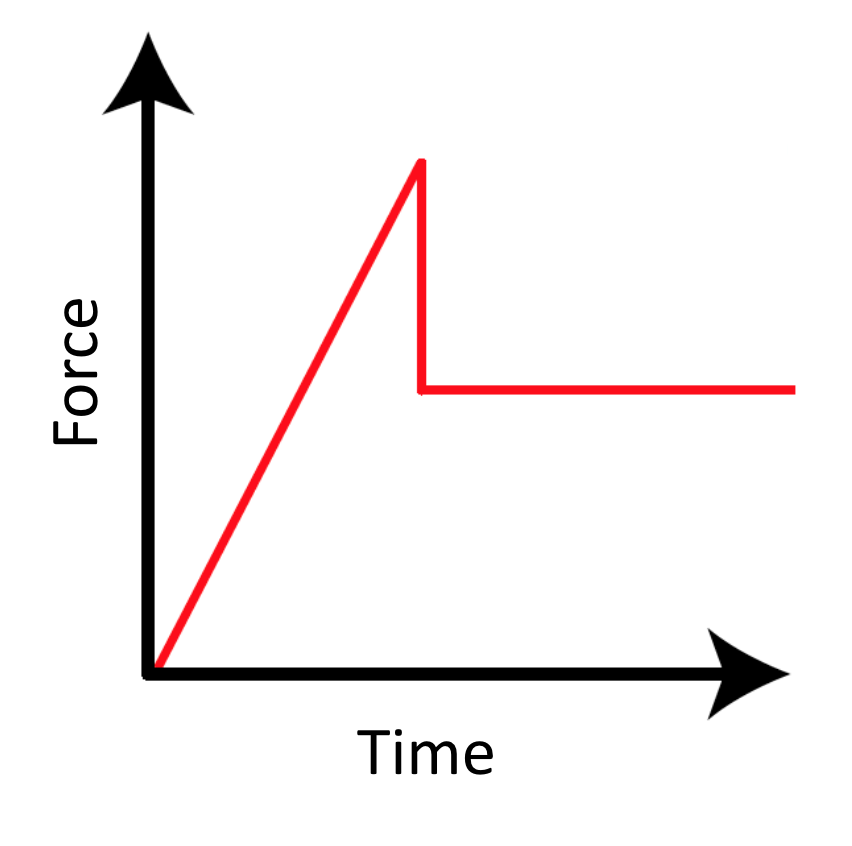
One of the characteristics of friction between two solid objects is that it decreases once the objects start sliding. You may have noticed this when pushing a heavy box: it’s hard to get the box moving, but once it budges it’s easier to continue pushing. This idea is shown in Figure 1 as a plot of force applied to an object versus the amount of time that force is applied. The force increases linearly before the object begins to move, then drops suddenly to a constant value after the object starts sliding. 

Figure 1. Force applied to an object with respect to the amount of time that force is applied for a typical solid object sitting on a solid surface. The force increases linearly before the object begins to move, then drops suddenly to a constant value after the object starts sliding. (Figure adapted from original article)

In this week’s article, Gao and colleagues devise a clever system for measuring the same type of force for a drop of liquid sitting on a solid surface. 

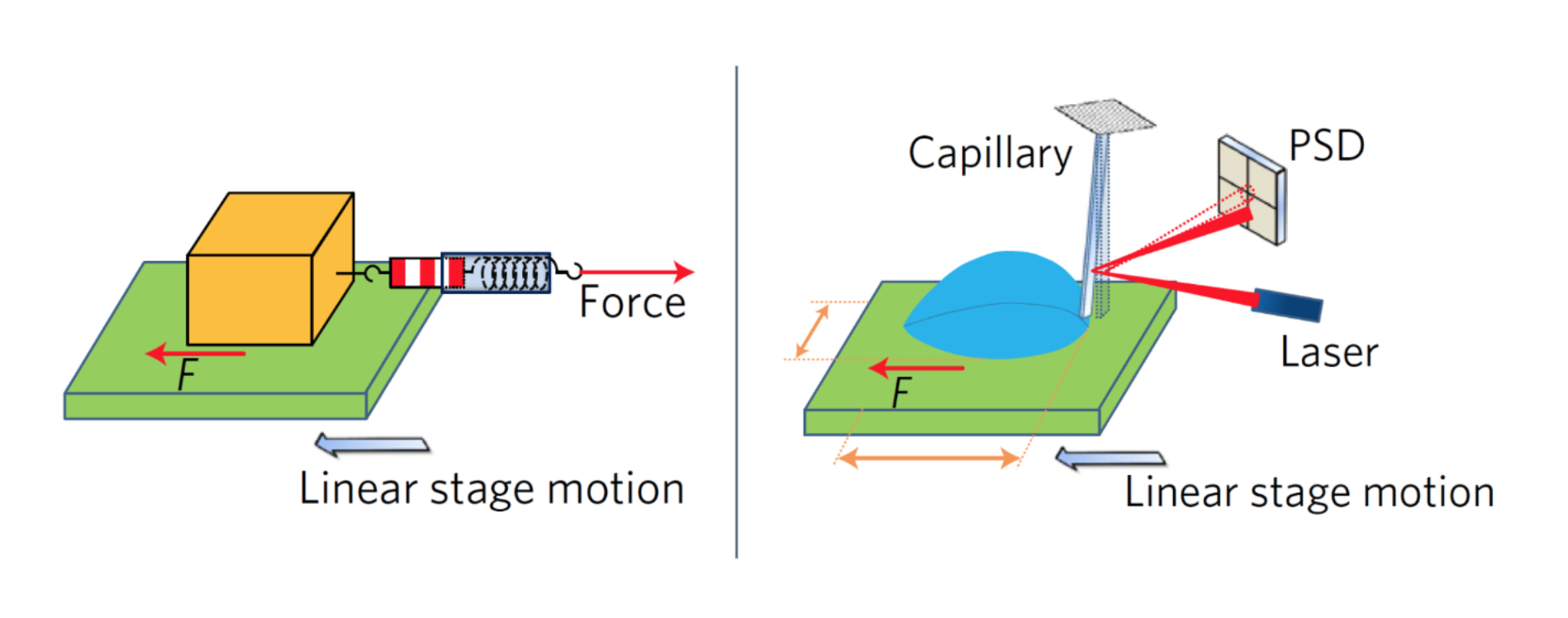
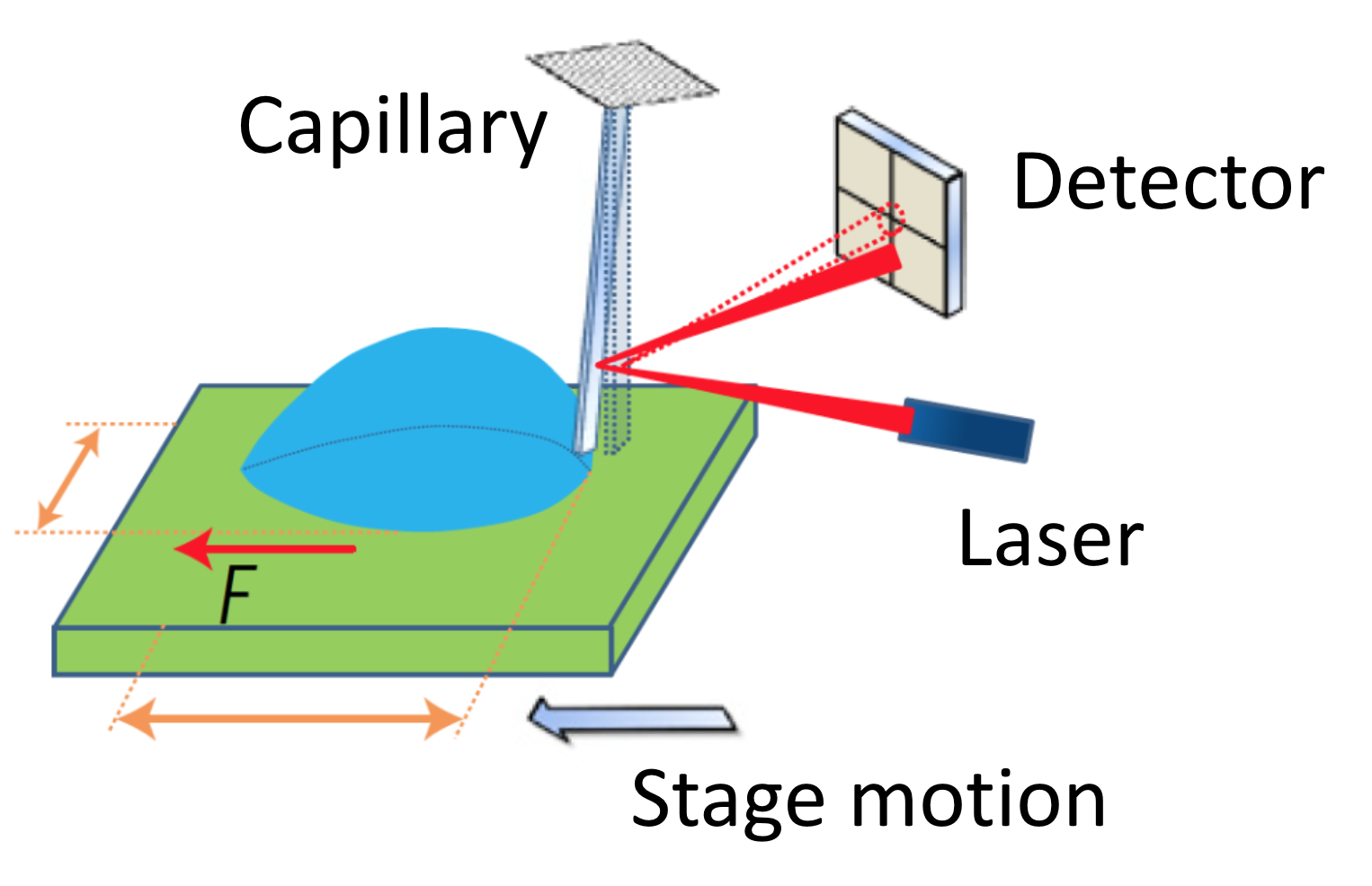
A drop sits on a platform that can be translated in one direction. Inserted in the top of the drop is a thin rod, called a capillary, which remains stationary even as the platform moves. Just as water will stick to your straw as you pull the straw out of your drink, the drop likes to be in contact with the capillary. So rather than simply moving along with the translating platform, the drop pulls on the capillary, causing it to bend. In turn, the capillary pulls back on the drop until the capillary exerts a force on the drop that overcomes the friction between the drop and the platform; the drop stops moving with the platform and remains stuck to the capillary.

As shown in Figure 2, the researchers tracked the position of a laser reflected off the capillary to measure how much the capillary bent. They were then able to back out the so-called “adhesion force,” which is an indicator of the force needed to make the drop move relative to the surface it’s sitting on. 

Figure 2. Cartoon of the setup used. The force due to friction between the drop and the platform, which points in the direction the platform is moving, is represented with a red arrow and labeled “F”. Here, the capillary’s bend is measured by detecting the reflection of a laser (shown in red) off of the capillary. The orange arrows show the length and width of the drop.

Gao and colleagues found that as the platform moves, the adhesion force increases more or less linearly before dropping back to a roughly constant value (see Figure 3). Sound familiar? Just compare with Figure 1 and you’ll see that this behavior strongly mimics friction between two solid surfaces.

Figure 3. Adhesion force of a drop of water on a moving surface of titanium dioxide as a function of time the surface has been moving. Measured values (from the bending of the capillary) are shown as blue circles and calculated values (from an equation for the adhesion force that depends on the shape of the drop) are shown as red squares. In both cases, the force increases roughly linearly for several seconds, reaching a maximum force of 100 uN before dropping to a constant force around 40 uN. (Figure adapted from original article)

This wasn’t just a lucky choice of liquids and solids — they found a similar effect for several fluids on surfaces ranging from titanium dioxide to silicone nanofilaments to goose feathers. The appearance of this effect in such a wide variety of systems suggests that this may be a general phenomenon.

Moreover, their measured values from the bend of the capillary match fairly well with values calculated independently using geometric parameters of their drops like the drop width, drop length, and angles the drop makes with the surface.

Even in systems as simple as a drop of water sitting on a surface, there is an incredible amount of physical richness, which means lots of science still to be explored. And it’s not just how drops stick — how drops land on a surface and how they evaporate both raise unexpectedly subtle and complex questions (see previous posts here and here). What area of drop-related research might physicists slide into next? 


For an even shorter summary of this article, see  https://phys.org/news/2017-11-droplet-friction-similar-solid.html

Synthetic blood to power vascularized robots

New soft robots can flex their muscles with synthetic “robot blood” and multipurpose circulatory organs.

Original paper: Aubin, C. A. et al. Electrolytic vascular systems for energy-dense robots. Nature 571, 51–57 (2019)

The circulatory or vascular system of animals is a complex organ that performs multiple functions simultaneously. Take the human circulatory system for example: it transports oxygen and nutrients throughout the body, regulates temperature, helps in fighting diseases, etc. However, robots don’t usually function the same way. Despite the vast improvements in robot design, they still cannot do much multi-tasking. Part of the problem is that robots are typically built from rigid parts that only do one thing. A battery usually does not play any other role aside from providing energy, and moving parts are typically controlled by independent actuators.  These single-purpose components (such as batteries) are typically less efficient than their biologic counterparts, and add to the weight of the robots (limiting their performance, maneuverability, speed, and autonomy).

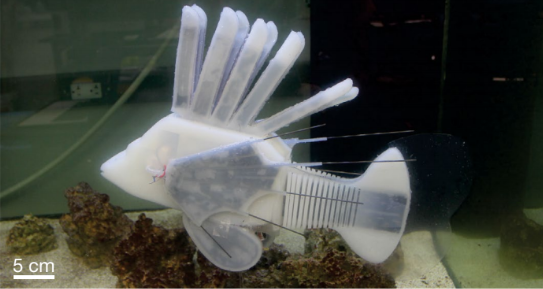
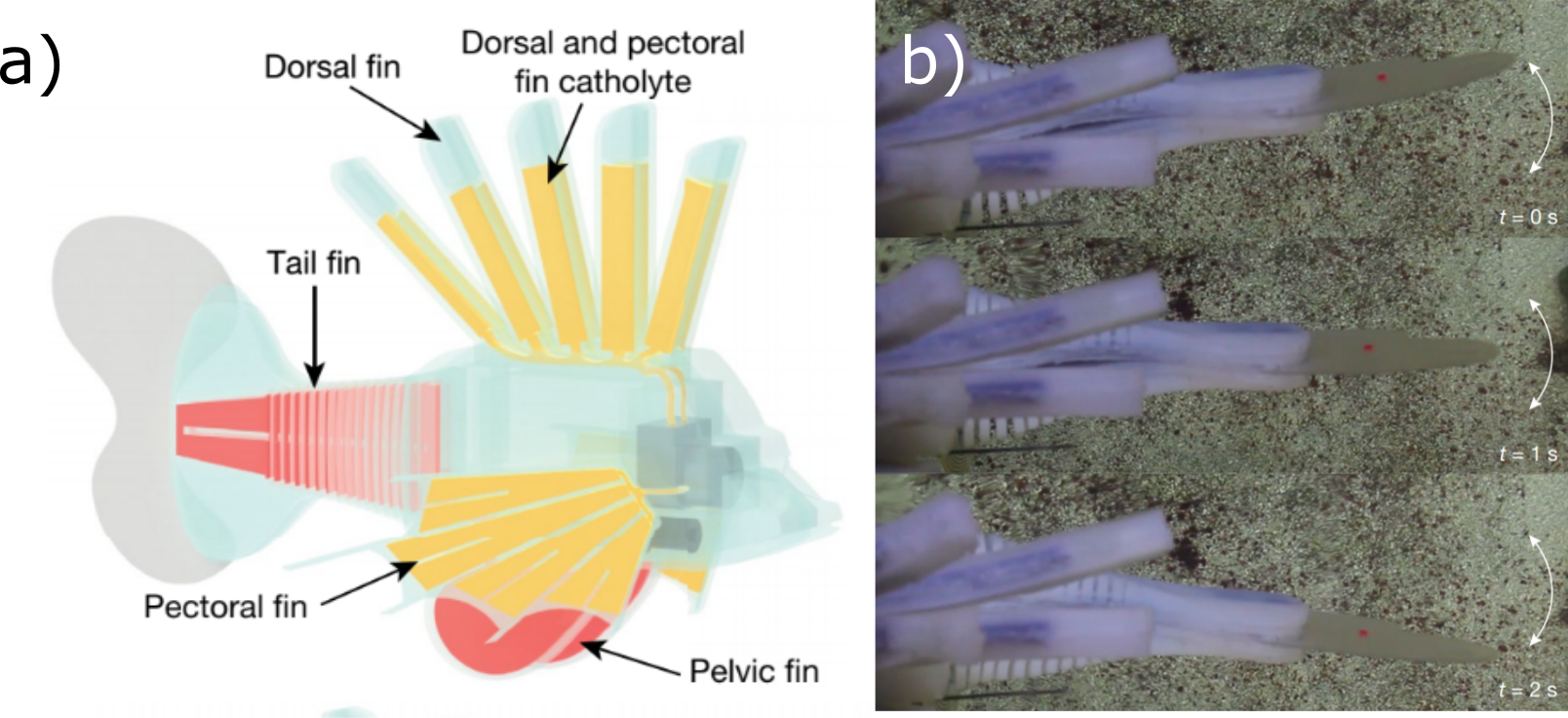
In order to create multi-functional robots, we can take inspiration from biology and build them out of multi-purpose components. A research team led by Robert F. Shepherd from Cornell University (NY, USA) has found a way around this problem by integrating a multifunctional circulatory system into untethered, autonomous soft robots. In a recent issue of Nature, they present an aquatic soft robot with a synthetic circulatory system which provides chemical energy. The synthetic blood has zinc and iodide ions that make it electrically conducting (like an electrolytic blood), and powers an artificial heart (a pump that circulates “blood” throughout the robot body). Rather than using traditionally rigid materials to build the robot, the circulatory system is encased in a soft, flexible body made out of stretchable silicone. The circulating “blood” can deform the flexible body of the robot when pumped through the vascularized fins, like electrolytic “robot blood” flexing a muscle, moving the fins of the fish and propelling the robot forward  (Figure 1, Video 1). By bringing materials and robot design closer to complex biological systems, their multifunctional synthetic vascular system can combine hydraulic force transmission, mechanical actuation, and energy storage (killing not two but three birds with one stone).

Figure 1. Lionfish-inspired robot powered by an electrolytic vascular system. a) Schematic shows synthetic blood in the tail fin (red) and in the dorsal and pectoral fins (yellow). b) The synthetic blood circulates through the robot body and actuates the tail fin by expanding and contracting the silicone parts at each side (adapted from Aubin et al.)

Although flow batteries are less energy dense than their lithium ion equivalents, their integration in soft robotic platforms has significant advantages: the electrolyte can fill up most of the volume of the robot and act as the hydraulic system (without the need of additional space), and the surface area of the flow batteries inside the soft robot can be maximized for an increased energy capacity (hence the large area of dorsal fins). With this approach, the autonomous robot can swim upstream for long operation times (up to 36 hours). 

Video 1. Autonomous lionfish-inspired robot swimming.

The proposed bio-inspired approach reduces the gap between biological complex systems and synthetic, traditionally bulky robotic platforms. According to the authors, “this concept can be generalized to other machines and robots”, which opens a wide design space for multifunctional soft machines, from materials design to actuation and control. Such improvements in energy storage and performance could advance the development of soft robots for search-and-rescue operations, marine exploration, inspection of underwater pipelines, and coral reef health monitoring (all applications where autonomy and safety are critical). Although still in its infancy, “robot blood” could one day power, actuate, and control untethered soft robots that can safely and autonomously interact with humans in delicate environments. And just like in science fiction, robots with synthetic organs and circulatory systems could one day live among us.

Soft engines: Leidenfrost effect in elastic solids

Original article: Coupling the Leidenfrost effect and elastic deformations to power sustained bouncing

Have you ever wondered why a water droplet rolls around on a hot pan instead of evaporating instantly? The part of the droplet touching the pan does indeed evaporate. The resulting vapor forms a thin insulating layer that enables the drop to hover over the pan for seconds, even minutes. This is known as the Leidenfrost effect. Because they also produce vapor when heated, sublimable solids (solids that skip over the liquid phase and directly produce vapor) also exhibit the Leidenfrost effect. This effect has been studied extensively for both liquids and sublimable solids.

In their letter in Nature (2017), Waitukaitis et al. studied the Leidenfrost effect for the first time in soft elastic solids. They used hydrogels, polymer networks that can absorb water. Because they can contain up to 99% water by volume, hydrogels are deformable and bendy. Contact lenses, for example, are hydrogels. The large water content provides vapor, making hydrogels ideal soft candidates for the Leidenfrost effect.

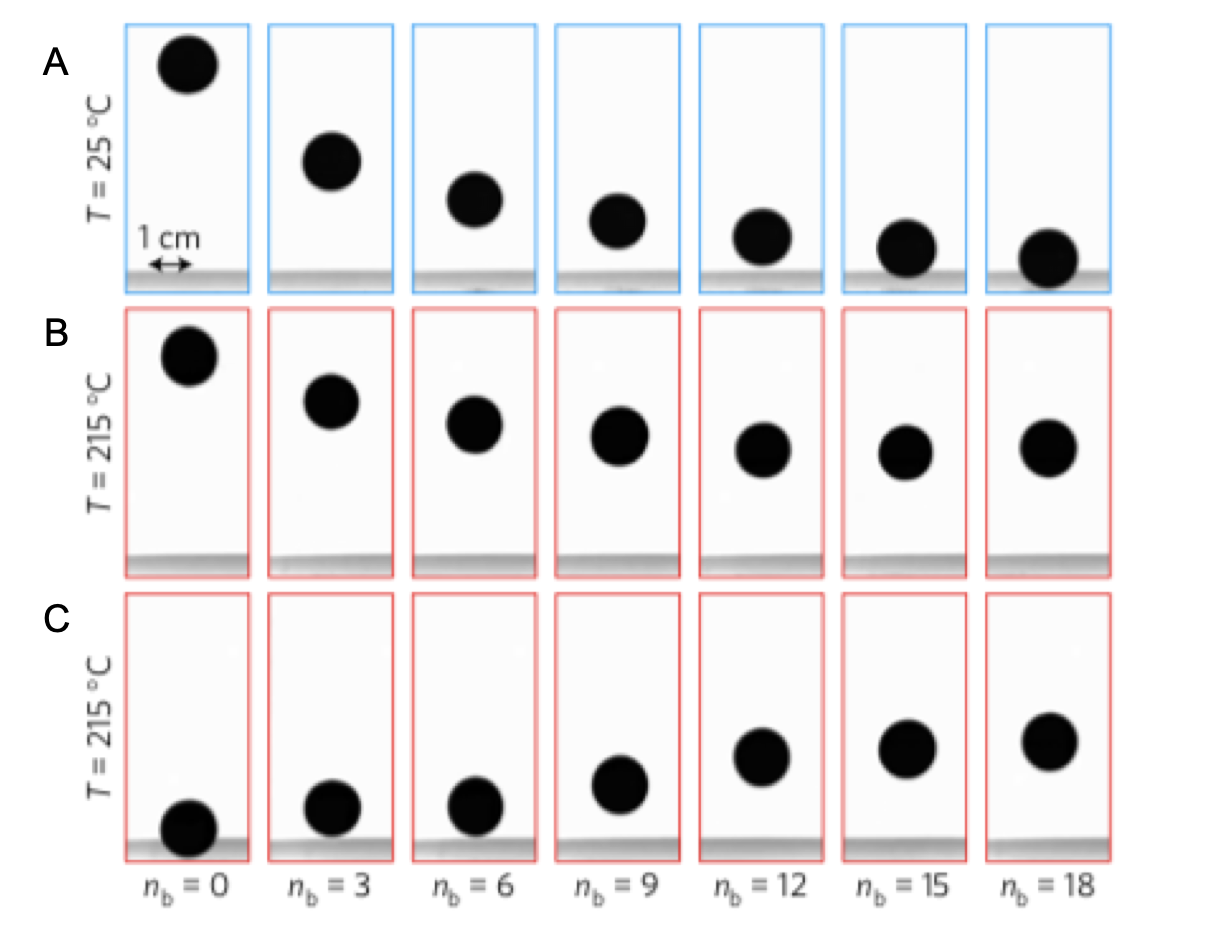
Figure 1. Bounce height vs. number of bounces (nb) for a gel (A) dropped on the cold plate, (B) dropped from h>h0 on the hot plate, and (C) dropped from h<h0 on a hot plate. The gel on the cold plate successively bounced to lower heights before coming to rest, but on the hot plate it achieved the same steady bounce height (h0) irrespective of the initial dropping height (Figure adapted from original article).

In their experiment, the researchers dropped a hydrogel sphere ~1.5 cm in diameter on a hot plate and recorded its activity. As seen in Figure 1B, the sphere eventually bounced at a constant height h0~3.5 cm around 1000 times. The sphere finally came to a stop when it cracked due to heat and water loss. A sphere dropped from a lower height also eventually bounced at the height h0 (see Figure 1C). This was surprising when compared to the behavior of an identical gel bouncing on a cold plate. As seen in Figure 1A, the gel on the cold plate successively bounced at lower heights and eventually stopped, just like a tennis ball would. Existence of a constant bounce height on a hot plate suggested that the hydrogel gained kinetic energy during its collisions with the hot surface.

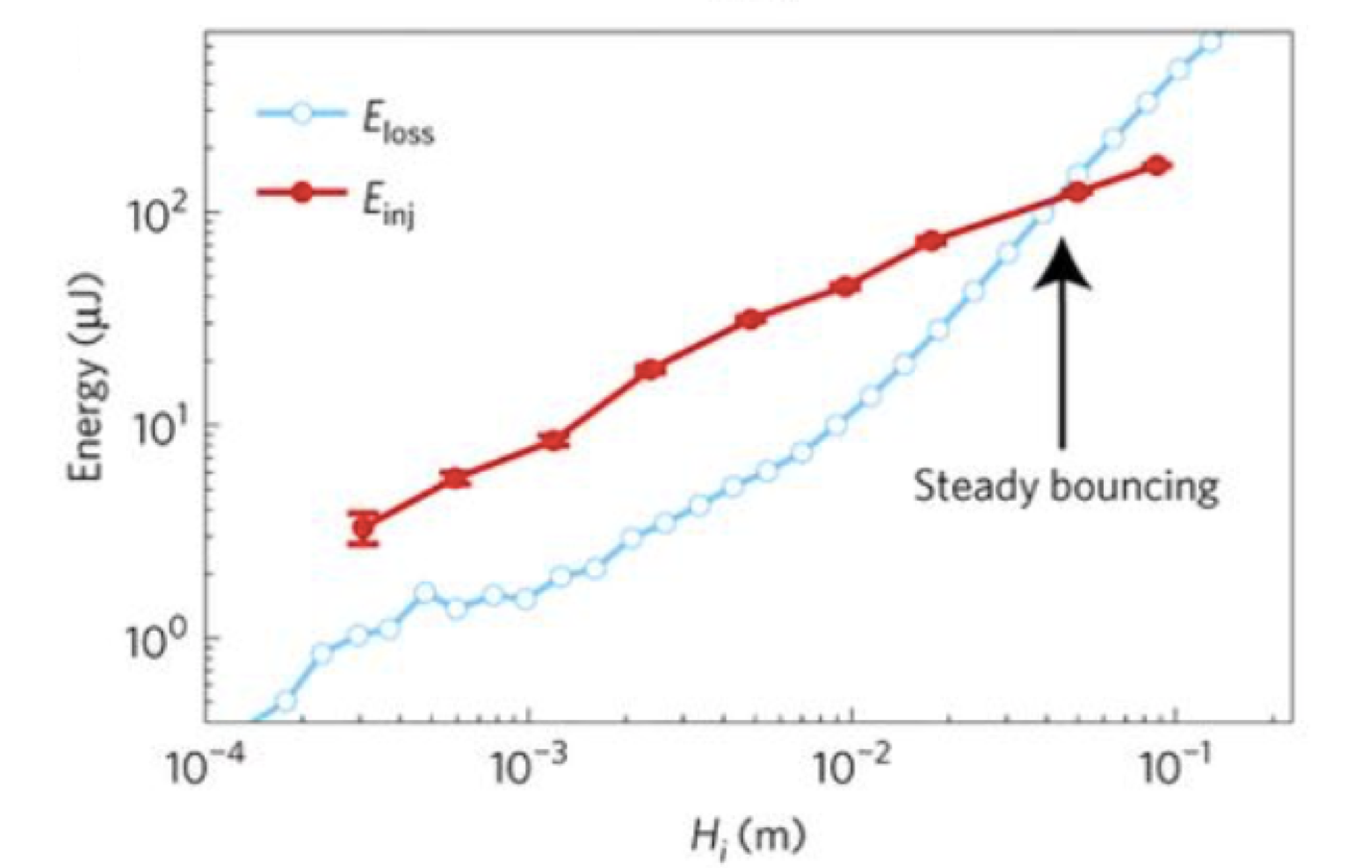
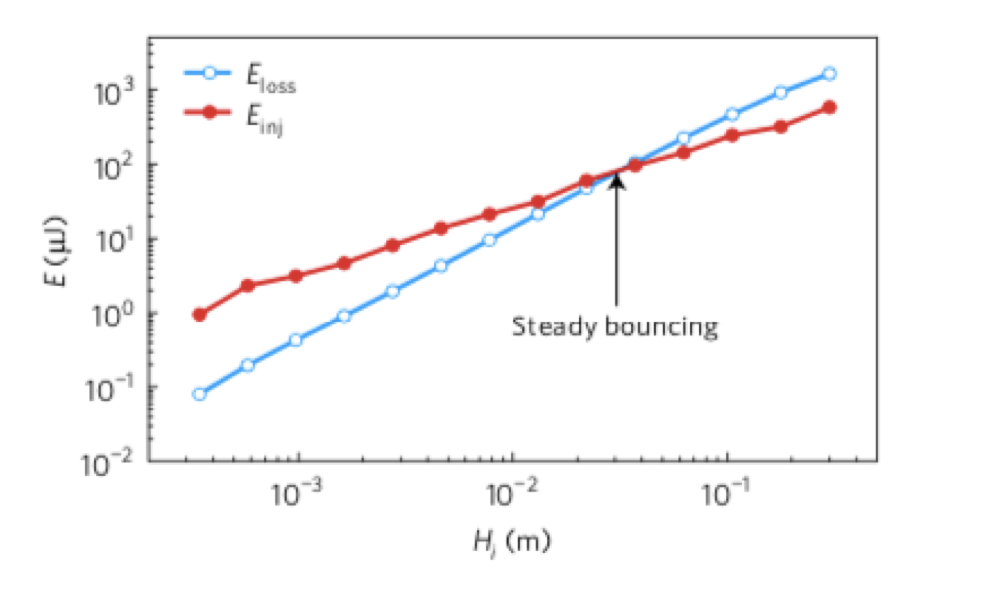
Figure 2. Red: Experimental data for energy gained on a hot plate vs. initial drop height. Blue: Experimental data for energy lost on a cold plate vs. initial drop height. The two lines cross at ~3.5 cm, the constant bounce height (Figure adapted from original article).

The authors repeated this experiment for different initial drop heights to obtain the kinetic energy gained as a function of the drop height (see Figure 2). Comparing the kinetic energy gained on the hot plate to the energy lost on the cold plate, the researchers found that there was a sweet spot where the energy lost and gained cancel each other out. This sweet spot was exactly at h0! Thus, once the gel reached the bounce height h0, it kept bouncing at the same height until it lost its elasticity due to cracking. 

Figure 3. Red: Model prediction for energy gained on a hot plate vs. initial drop height.
Blue: Energy lost on a cold plate vs. initial drop height due to inelastic collision. The prediction as well as the crossover point show good agreement with the experimental data. (Figure adapted from original article).

To understand the mechanism of bouncing, the researchers looked at the impact at a high resolution. During impact, a gap opened up between the hydrogel and the plate, and the thickness of this gap oscillated between 0 and 100 ?m several times. The authors proposed the following physical process to explain the kinetic energy gain of the hydrogel. When the gel touches the hot plate, a small amount of water evaporates. The vapor deforms the gel bottom and gets trapped in a pocket between the gel and the plate. As the pressure builds up inside the pocket, the vapor eventually escapes. The gel bottom then elastically recoils towards the plate. This gap oscillation repeats itself several times. According to the authors, work is done on the hydrogel during each such oscillation. The gel therefore gains a small amount of energy from the hot plate, effectively acting as a tiny engine. The authors also numerically modeled the gel as a vertical chain of masses connected with springs between them and considered the forces acting on each mass. Despite being much simpler than the real system, the model’s predictions showed good agreement with the experimental results (see Figure 3).

In conclusion, the researchers studied the Leidenfrost effect in elastic hydrogels. Even though the experimental details were similar for the regular (liquids and sublimable solids) and the elastic (hydrogels) Leidenfrost effects, the mechanisms for the two phenomena are different. In the regular Leidenfrost effect, there is no transfer of energy between the hot plate and a liquid drop. However, for a soft hydrogel, the elastic oscillations of the gel bottom convert some of the heat energy from the plate into the elastic (and in turn kinetic) energy of the gel, enabling it to bounce at a steady height. According to the authors, the gel is “effectively a soft engine that harvests energy from the hot surface,” with water vapor acting as a fuel. This research may have exciting implications for robotics. Most conventional robots are made of hard materials, but it is desirable to have soft and bendy robots for performing human-like functions. This work with elastic hydrogels that can be energized with heat could lead to self-actuating soft robots. 

The Future of Shape-Memory Polymers: Just Add Water and Glycerol

Original paper: Magnetically Addressable Shape-Memory and Stiffening in a Composite Elastomer


Video 1. Heat-shrink tubing demonstration.

Have you ever used heat-shrink tubing at home to seal an exposed wire? As shown in Video 1, you would place the tubing around your wire, apply heat, and voilà! The tubing shrinks and tightly wraps itself onto the exposed wire, and you don’t have to worry about an electric shock anymore. This type of material that changes its shape upon increased temperature is called a shape-memory polymer. Since its commercial development in 1962, scientists have found this type of material so useful that its popularity rose, especially in the biomedical and aerospace fields. However, it comes with a few drawbacks: applying the desired temperature uniformly can be tricky and the shape change induced by the heat can be quite slow. In addition, changing the temperature isn’t ideal for biological applications where the environment surrounding the material is sensitive to heat, such as in tissues and living cells. In today’s post, I’ll introduce you to a different type of shape-memory material that “remembers” its temporary shape when subjected to a magnetic field, instead of heat.

Video 2. Demonstration of the material developed by the authors.

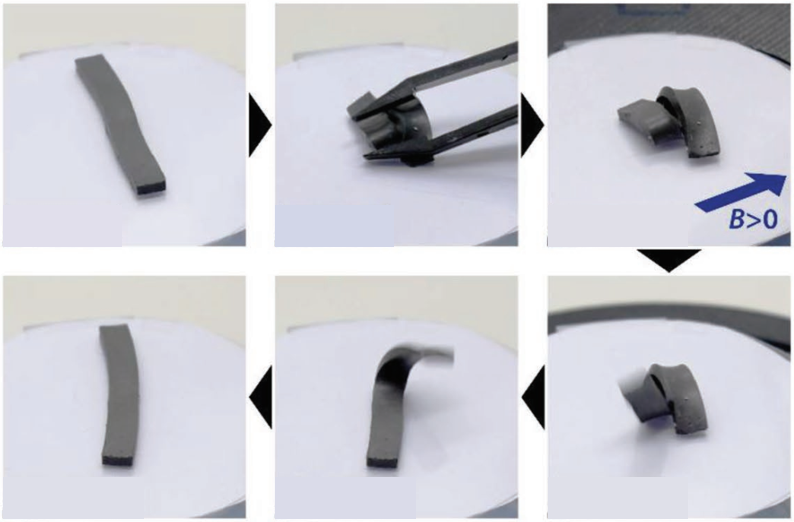
Paolo Testa and coworkers from the Paul Scherrer Institute and ETH Zurich developed a shape-memory polymer composite that can preserve a new shape when a magnetic field is present. As you can see in Video 2, the initially flexible material sitting on the center stage is manually twisted with a tweezer and held by force. When the magnetic ring is raised around the stage and held up so that the material can “feel” the magnetic field, the material “freezes” in its twisted shape, even when the tweezer is removed. After a certain time, the magnetic ring is removed and the material regains its original shape within one second, dramatically faster than the time it took for a heat-shrink tubing in Video 1 to change its shape. The material—at least a part of it—that looks like black rubber is a flexible polymer that is the main ingredient of the Silly Putty, called poly(dimethylsiloxane) (PDMS). However, PDMS is normally transparent in color, and PDMS itself isn’t a shape-memory polymer. So what makes it black and capable of holding the twist when the magnetic field is present?

The answer is in iron particles. However, iron particles alone cannot perform well enough. Shape-memory materials that were previously developed had iron particles directly embedded in the polymer but didn’t have such a high sensitivity to magnetic fields. What makes the material in this paper so unique is the liquid surrounding the particles. The iron particles are dispersed in a water and glycerol mixture, making the fluid six times more viscous and stiff when subjected to the magnetic field. This type of fluid, called a magneto-rheological fluid, is then injected into the PDMS polymer, making the material sensitive to the presence of a magnetic field.

3D visualization of the material and 2D slices of that visualization with and without magnetic field
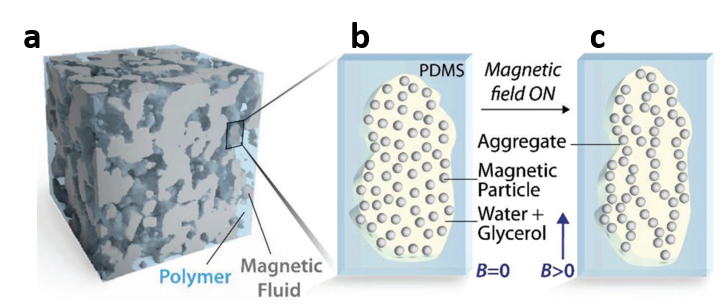
Figure 1. (a) 3D visualization of the PDMS injected with magneto-rheological fluid. (b)(c) 2D slices of a droplet surrounded by PDMS with the magnetic field (b) off and (c) on. (Adapted from the original paper.)

Figure 1 shows the 3D structure of the developed material, as well as a 2D schematic of a magneto-rheological fluid droplet with and without the magnetic field. When the fluid is injected into the polymer, the polymer encases the fluid and a composite is formed, which is shown in Figure 1a. In the absence of the magnetic field, shown in Figure 1b, the iron particles are dispersed and mobile inside the fluid droplet. However, when the magnetic field is turned on, shown in Figure 1c, the particles reorganize and align along the direction of the magnetic field, and, in turn, the droplet stiffens. The alignment of the iron particles and the resulting stiffening of the fluid, induced by the presence of a magnetic field, are the reasons why the polymer composite can hold its new shape (as in Video 2). When the magnetic field is removed, the particles regain their mobility and the fluid droplets soften, which lets the polymer return to its original shape.

On the left, a graph of stiffness as a function of the fluid volume fraction. In the middle, a graph of connectivity as a function of the fluid volume fraction. On the right, two 3D construction of material's internal structure, one representing 10% fluid and the other representing 40% fluid.
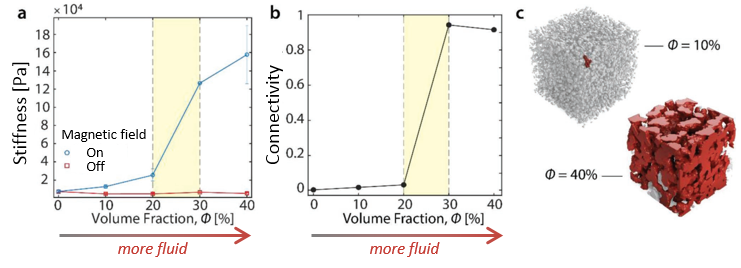
Figure 2. (a) The volume fraction (ratio) of magneto-rheological fluid over PDMS (?) versus the material stiffness. The blue and red lines indicate the magnetic field being on and off, respectively. (b) The volume fraction (ratio) of magneto-rheological fluid over PDMS (?) versus the connectivity between the fluid droplets. (c) 3D reconstructions of the material’s internal structure when the fluid occupies 10% (top) and 40% (bottom) of the total volume. PDMS and the fluid are represented in grey and red, respectively. (Adapted from the original paper.)

By controlling the ratio between the magneto-rheological fluid and PDMS (?), the authors tried to understand the relationship between the stiffness and structure of the material and the said ratio. When the percentage of the fluid increases, as shown in Figure 2a, the overall stiffness of the material measured in the presence of the magnetic field increases as well. This increase is enhanced when fluid occupies more than 20% in volume, as highlighted in yellow in Figure 2a. Compared to a factor of two increase going from 10% to 20%, the stiffness increases by a factor of 13 going from 10% to 30%.

By measuring the connectivity [1] between the fluid droplets using an X-ray scan [2], the authors discovered that the stiffness increase is related to the network connection between the fluid droplets when the magnetic field is applied (Figure 2b). This network connection is visualized in Figure 2c; the fluid, shown in red, is isolated when the fluid composes only 10%. However, when increased to 40%, the dispersed fluid pockets become connected to one another, enhancing the stiffness of the overall material under the magnetic field.

As mentioned above, the addition of the fluid was the key to the material’s drastic functional improvement. Since the fluid provides freedom for the iron particles to move around and align under the magnetic field, the stiffening process becomes more dramatic compared to having the particles alone inside the polymer. Also, the fluid acts as a buffer, lessening any damages caused to the polymer by the motion of the hard particles. The authors hope that their research will open up an even wider range of applications using this shape-memory polymer, such as a magnetic-controlled micromachine that can deliver drugs to targeted areas inside our body. Unlike the temperature-controlled shape-memory material introduced in the beginning, the stiffening of this new magnetically controlled shape-memory material is reversible. This might offer a greater potential for new applications which might require several cycles of deformation. Maybe in the near future, we’ll use items made out of magnetically controlled shape-memory polymers in our daily lives.


[1] The connectivity is defined as the volume of the biggest droplet over the total volume of the magneto-rheological fluid in the polymer composite.^

[2] The authors used X-ray tomography, a method where a 3D image is constructed using 2D X-ray images.^


Small structures, Big facilities

Science Village Scandinavia

I am writing this as I embark on a journey from Copenhagen to Chicago for a 24-hour experiment. Luckily, I am going to be in the city longer than I will be flying, but only just. Traveling over 4,000 miles may seem like a long way to go for an experiment, and it is. I perform small-angle scattering experiments for a living though, and sometimes this is just what needs to be done. My previous post on Softbites was all about the fundamentals of X-ray and neutron scattering, but I didn’t give an indication of what an experiment is actually like. This post focuses on the practicalities. What are the experimental facilities like? What do you have to do to access them?

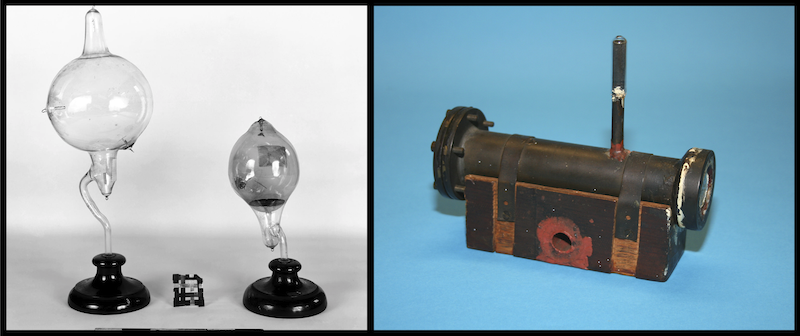
The first X-ray and neutron sources (developed by Röntgen and Chadwick, both of whom duly received Nobel Prizes for their discoveries) could fit on a desktop; examples are shown in Figure 1. Unfortunately, these historical apparatuses produce insufficient X-ray or neutron intensity for the kind of experiments that actually make use of the radiation. To enable these experiments, large-scale facilities have been built across the world, which produce much higher fluxes. For example, a next generation X-ray source will be 1015 times more brilliant than one of these historical X-ray tubes, and a new neutron source will have a flux 1018 times greater than that produced by Chadwick. The greater intensity of X-rays and neutrons generated at these large-scale facilities not only makes measurements possible but enables smaller and smaller samples to be analyzed at higher and higher throughputs.

Early apparatuses to produce X-rays and neutrons.
Figure 1. Early apparatuses to produce X-rays and neutrons. (Left) Crookes tube with concave cathode, the early way to produce X-rays. (Image from the Science Museum Group Collection, copyright The Board of Trustees of the Science Museum) (Right) James Chadwick’s Neutron Chamber device. (Image from the Department of Physics, The Cavendish Laboratory, University of Cambridge)

Intense and well-defined X-ray beams are primarily produced by the acceleration of electrons in machines called synchrotrons, which emit X-rays when magnets are used to bend electrons as they travel around the ring. Neutron beams are produced either by a nuclear reactor or at a spallation source, which emit neutrons from a metal target that has been bombarded by high energy protons. None of these are on the scale of a typical laboratory though, and instead, they require large-scale facilities.

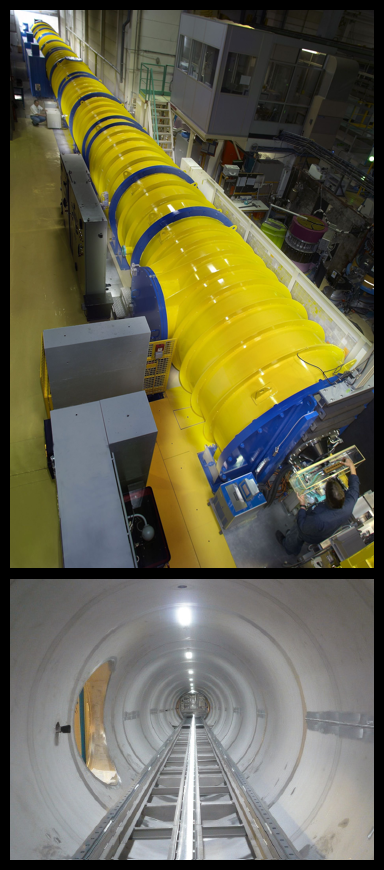
These large-scale facilities are definitely required for some small-angle scattering experiments. The larger a particle is, the smaller an angle that it will scatter at. Small-angle scattering measurements do indeed measure very small angles (less than 1°). This means that large distances between samples and detectors are required to measure scattering at these very small angles. There are instruments with 40 meter vacuum tanks and even 100 meter vacuum tanks. Examples of some long instruments are shown in Figure 2. This means that the size of the structures you are studying (ångströms, nanometers or micrometers) is very out of proportion with the size of the facilities you use (multiple meters).

ng instruments for neutron and X-ray scattering.
Figure 2. Long instruments for neutron and X-ray scattering. (Top) The new 40m long detector tank of the small angle neutron scattering (SANS) instrument D11, at the Institut Laue–Langevin. (Image from Peter Lindner) (Bottom) Inside view of the 34 m detector tube at ID02 at the ESRF. The detector that measures scattered X-rays travels along the tube. (Image from T. Narayanan)

The ability of some instruments to access very long length scales from scattering at very small angles is the exact reason for my journey to the Advanced Photon Source (APS) near Chicago. For this experiment, I am interested in studying nanoparticles with diameters of several hundred nanometers but with interactions between particles that span distances much longer than this. To study interactions at the scale of micrometers, we need to measure scattering at the APS’s ultra-small-angle X-ray scattering instrument.

As you might guess given my long journey from Copenhagen to Chicago, there are a limited number of these instruments in the world. Even if there is a facility nearby, only a small number of samples can normally be measured rapidly, and even that might require waiting weeks or months. It is not possible to easily do test measurements at facilities, like you can with laboratory-based equipment. There are two ways to access time on these instruments, which as it is “time” on instruments using “beams” of X-rays or neutrons, is literally called “beamtime”.

Commercial access is more rapid, but it is costly (on the order of tens of thousands of dollars a day). Academic access costs less, and tends to be funded by the facility or a national fund, but you have to compete to get access this way. To gain beamtime via the academic route, I had to design and propose an experiment and have it accepted by a panel. Competing for and booking time at large-scale facilities is common in other fields, like astrophysics or particle physics. However, it is not typically necessary for soft matter experiments.

After being granted access by the panel for some beamtime on my desired instrument, the planning begins. The first thing to do is to schedule a time for the measurement with a local scientist at the facility. This might be during a weekend or a holiday, and I may have to be there overnight. I then need to update my radiation safety and awareness trainings and tests, which enables me to enter the facility, and book my travel. Finally, I prepare the samples, which I send to the facility a few weeks before my experiment. Once I arrive at the facility and familiarize myself with operating the instrument, I will finally perform my measurements. If all goes well, I will come home with a mountain of data to analyze. This time I am looking at nanoparticles, but depending on the materials I bring, I may reveal the structure of a protein or the size and shape of a micelle or the interactions between components in a complex mixture. There are a lot of possibilities in studying soft matter and biology. However, even if I haven’t found all the answers,  I should hopefully have enough preliminary data to write my next proposal. This may sound like a lot of work, but given the capabilities available on the instruments at large-scale facilities, we can really push the limits of what is achievable in soft material characterization. There are over 100 neutron and X-ray facilities around the world, and one may be near you. If not, you too may get to travel thousands of miles for a brief window of beamtime.


The featured image at the top is an impression of Science Village Scandinavia, which is designed to surround the new MAX IV X-ray synchrotron and ESS neutron source being constructed in Lund, Sweden. (Image from COBE.)

The dance of swarming flies

Original article: Emergent dynamics of laboratory insect swarms

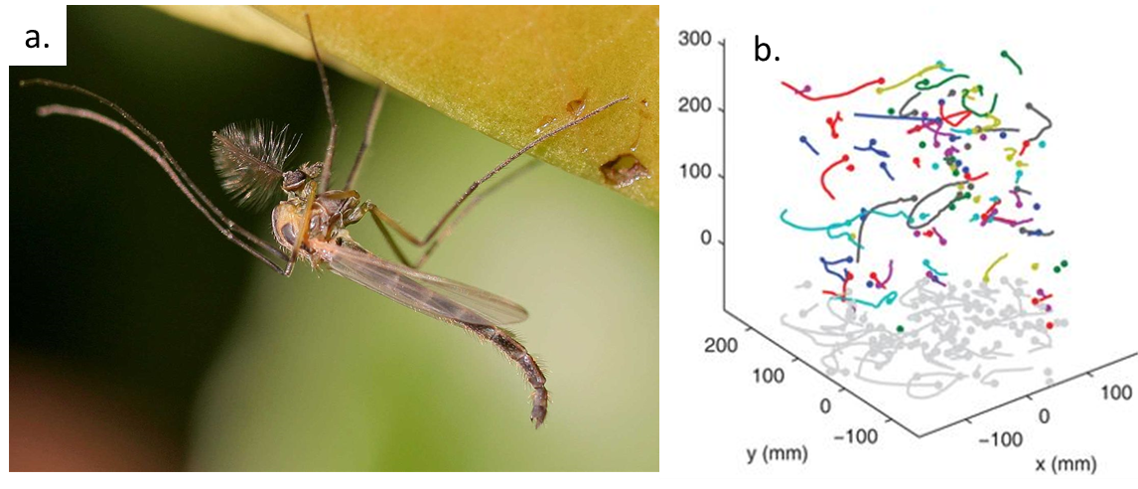
Imagine yourself as a small fly called a midge (shown in Figure 1a). You used to live in a lake as a small larva with no concerns in life except swimming, eating, and growing. One day, you hid underwater and formed a cocoon around your body as it developed wings, legs, and antennae. A few days later, you swam to the surface and burst out of your cocoon as an adult fly — a male. As a new adult male, you find the clock ticking – you have only a few days to find a mate before you die.

Attracting a female is difficult for a tiny midge – how is she going to see you flying around? Fortunately, you can team up with hundreds of other male midges. Together, you fly above the lake in a stationary swarm that looks like a large cloud. Females can find this swarm and fly into it for their choice of mate. 

In today’s study, Douglas Kelley and Nicholas Ouellette investigate how the motion of midges in a swarm helps the swarm stick together.

Figure 1. (a) A midge is a tiny fly that forms mating swarms above lakes (image from Wikipedia). (b) Midges tracked in a swarm in the laboratory, with different midges in different colors (Figure adapted from original article)

The researchers set up midge swarms in the laboratory and film them with three infrared cameras. They track all of the individual midges in the swarm and calculate their trajectories. Tracking dozens of small midges is not easy! First, they use the 2D images from the three cameras to locate the flies in 3D for each frame. Then, they use a technique originally developed for studying turbulent fluid flows to generate the trajectories over time. This technique uses the history of each midge to estimate where it is likely to be next and looks for midges in that area at the next time step. The resulting trajectories are shown in Figure 1b.  The positions, velocities, and accelerations of the midges give clues about how the swarm moves.

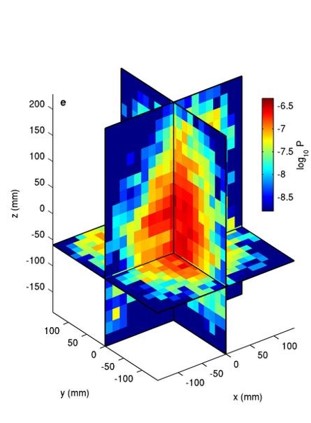
First, Kelley and Ouellette discuss the position of the midges. They plot the logarithm of the probability ($latex log_{10} P$) of finding a midge in a point in the swarm in three dimensions in Figure 2. Bright red represents a high probability of finding a midge, and blue represents a very low probability. Midge swarms are nearly symmetric, but larger swarms (of 100 individuals or more) are slightly taller than they are wide. This is unlike bird flocks, which are nearly two-dimensional.

Figure 2. Probability of finding a midge at x, y, and z coordinates in the swarm. Bright red colors indicate high likelihood of finding a midge, and blue represents a very low chance of finding a midge in that position. (Figure adapted from original article)

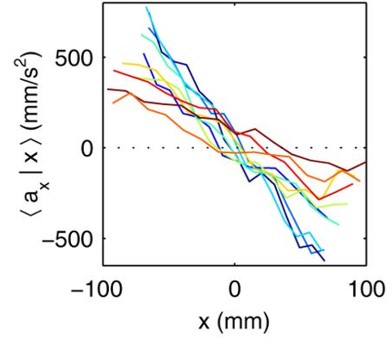
The researchers then investigate the velocities of the midges. Since the swarm is stationary, the average velocity of all the midges in the swarm is nearly zero. It turns out that the standard deviation, or the variation, of the velocities of the individual midges is more useful for understanding the motion inside the swarm. Midges fly twice as fast horizontally as vertically, just like birds in a flock. However, unlike flocks of birds, the midge swarms  are not polarized — a midge does not tend to fly in the same direction as its neighbors. Finally, Kelley and Ouellette investigate the acceleration of the midges in the swarm. The midges are equally likely to turn in any direction, unlike birds or fish. Relative to their body size, larger animals have more inertia than smaller ones, and must exert a lot more effort to turn, accelerate, and decelerate. Thus, they tend to keep moving in the direction they are currently moving. Midges, on the other hand, can turn and easily move in any direction. Kelley and Ouellette find the average acceleration of the midges in the swarm in the x-direction as a function of the midge’s x-position, $latex \langle a_x|x \rangle$, in Figure 3.  The midges tend to accelerate towards the center of the swarm, keeping the entire swarm together despite the midges’ constant motion. [1]

Figure 3. Acceleration of the midges in the x-direction as a function of the x-position for several midge swarms.  Each line represents a different swarm. When a midge is at the right edge of the swarm, it accelerates to the left (and vice versa).  (Figure adapted from original article)

In this study, Kelley and Ouellette quantify a new type of swarming behavior. Unlike most other animal aggregations like bird flocks and fish schools, midge swarms stay in one place, helping female midges find the love of their very short lives.


[1]  Surprisingly, when Kelley and Ouellette investigated the mean square displacement of the midges, they found that the midges act as if they are trapped in a box with walls.

Mighty-Morphin’ Magnetic Materials

Original paper: Printing ferromagnetic domains for untethered fast-transforming soft materials


If we could shrink a submarine down to the microscopic scale, could we pilot it into the human body to fight infection and perform surgery? Despite suggestions from futuristic sci-fi such as “Fantastic Voyage”, “Honey, I Shrunk the Kids”, “The Magic School Bus”, “Power Rangers”, and “Rick and Morty”, we cannot survive such shrinking and our vessel would be without a pilot. But it may still be possible to “shrink” down some of our technology and control it remotely as we will see from researchers at MIT in this week’s paper.

In their letter to Nature, author Yoonho Kim and colleagues at the Zhao lab reveal a dazzling zoo of tiny transformable machines. Following recent trends in the metamaterials community, they built a series of “origami” and “kirigami” samples inspired by the cutting and folding of traditional Japanese paper art.

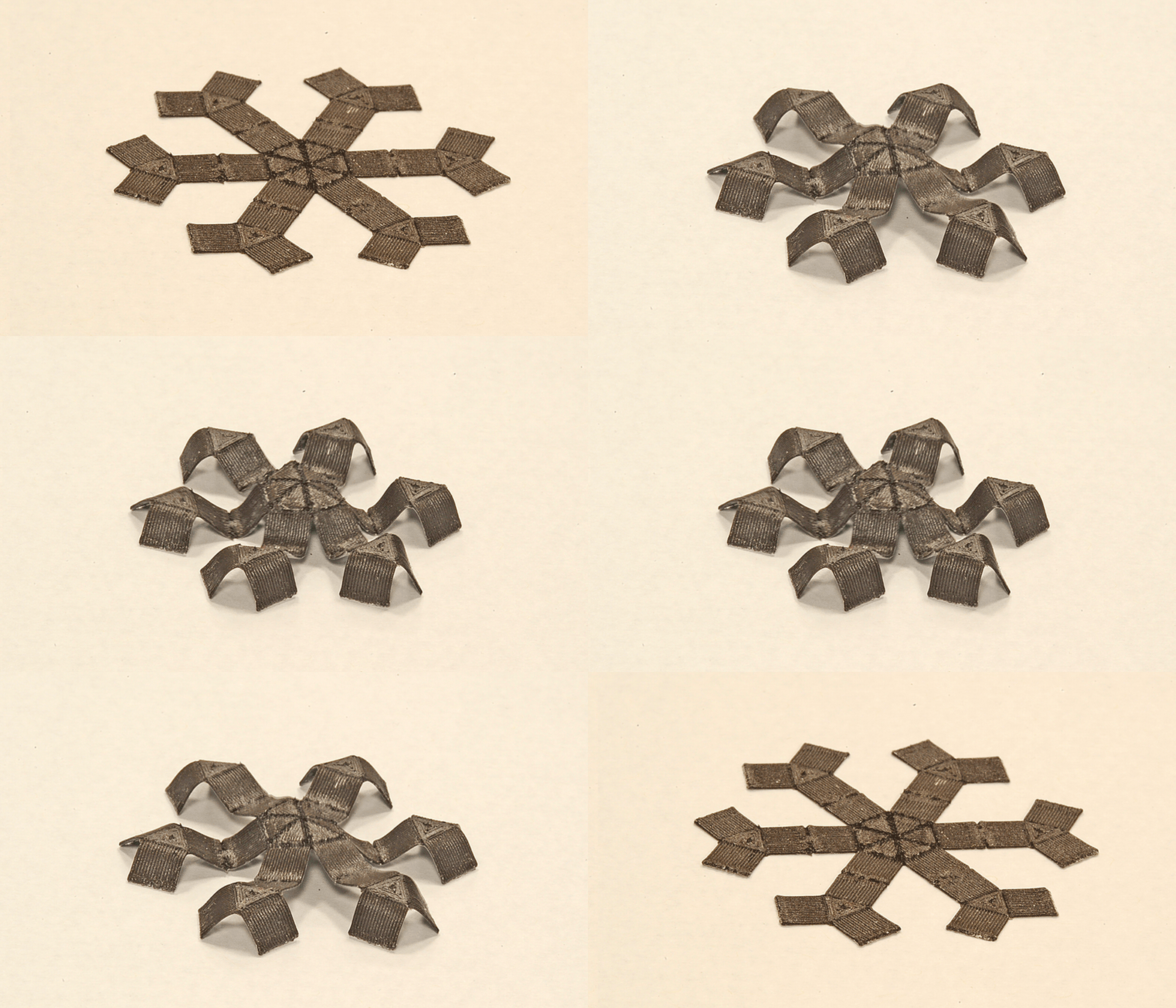
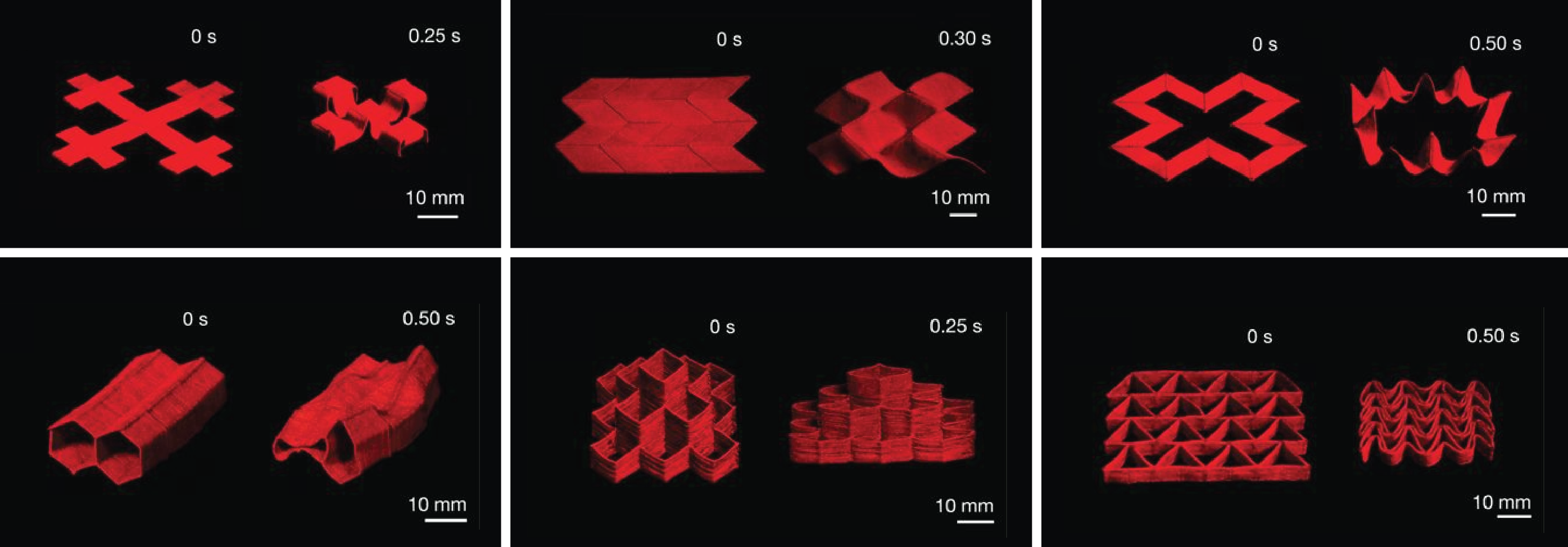
But, unlike traditional origami, these special sheet-like materials are able to fold themselves up and change shape on command, as shown in Figure 1. With this remarkable new technique, they assemble panels and tubes into a variety of structures which can shrink, shear, expand, and change shape, as well as pipes which can obstruct themselves on command. 

article_img_all_samples
Figure 1.  Microstructures made from thin, flexible magnetic panels fold and reshape themselves on command in less than 1 second.

To create these machines, Kim combines two relatively simple ingredients: 3D printing and magnets. These tiny gadgets do not resemble conventional robots and are better described as 3D printed flexible materials with specialized ferromagnetic regions. So let’s break these ingredients down piece-by-piece.      

The process of 3D printing involves a nozzle depositing an “ink”. As the ink leaves the nozzle, it sticks and transitions from a fluid state to a hard or rubbery state, becoming a solid piece of the “printout”. By choosing where to put these squirts of ink, a 3D printer is able to quickly and accurately build 3D structures. 

Typically this ink is some sort of molten plastic or rubber, but by including tiny magnetic bits in the ink and applying a magnetic field as it passes through the nozzle, the magnetic bits will reorient themselves and the ink can adopt the magnetic properties of the applied field. Then, as the ink hardens, this magnetic alignment will be “frozen in”. The result is a flexible material that “remembers” the magnetic field that was present when it formed. And what’s more, by changing the direction of the applied magnetic field over the course of printing, the material can be programmed with regions of different magnetic orientations.

Now, when this printed and patterned material is exposed to a magnetic field again, all these little magnetic regions of the material will try to align themselves with the field. The result is a controlled and predictable change of shape. Careful design of these magnetic domains by Kim and colleagues is the secret behind their self-folding origami as well as complex shrinking and reshaping materials, which seem to be just the tip of the iceberg.

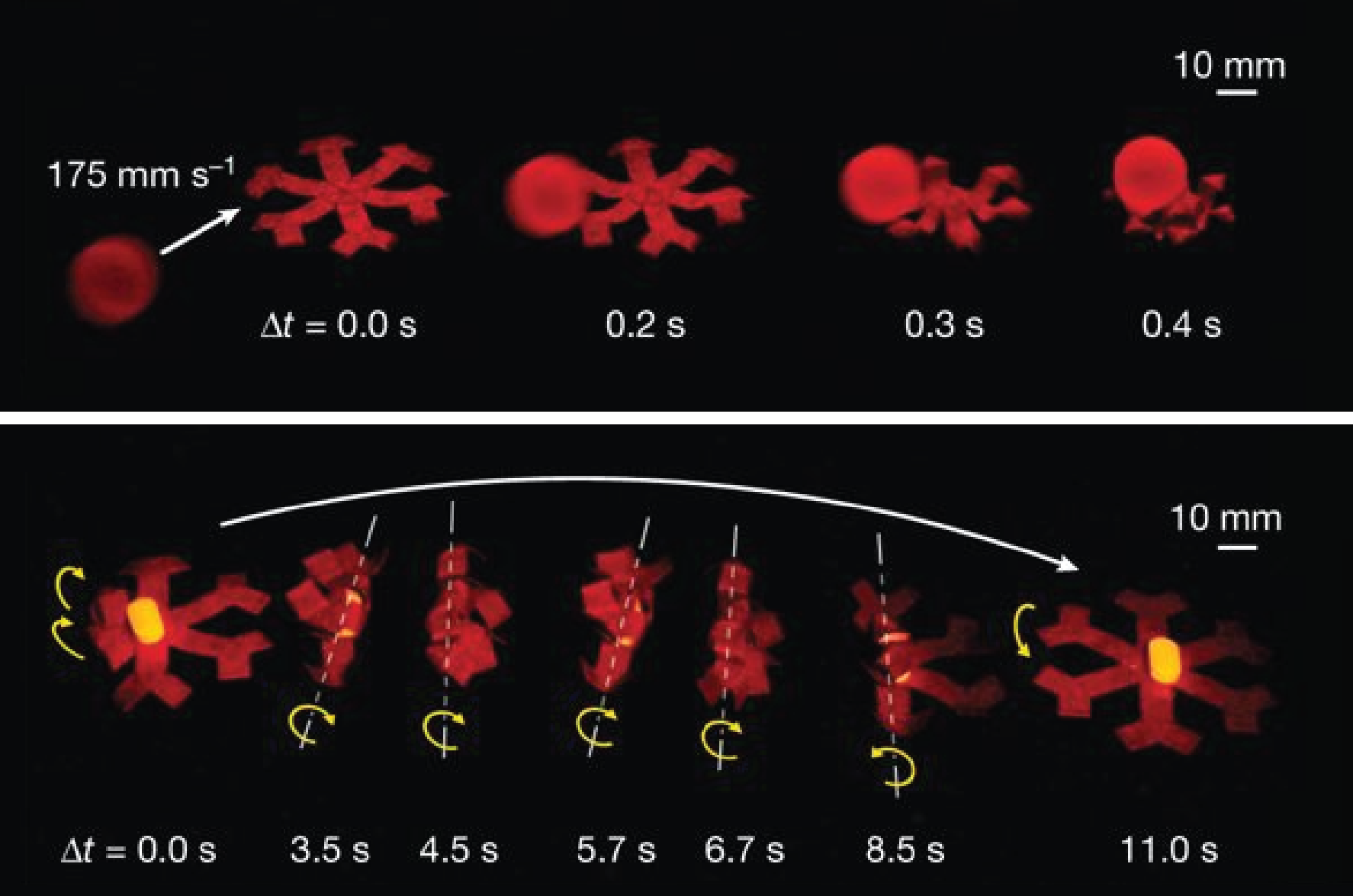
Figure 2. Controlled by an external magnetic field, a “soft robot” displays dual functionality by catching a fast moving object (top) and rolling a wrapped load across a distance (bottom). 

While all these machines are controlled remotely, the material design is permanent and raises questions of multifunctionality. As an inspiring counterexample, the researchers present a flat “soft robot” which can crawl, catch, and can even wrap and roll a small load across a distance as shown in Figure 2. The variety of moves available to this robot stem from clever dynamic variations of the external magnetic field. To really appreciate all of these devices, be sure to check out the videos in the Supplementary Section in the paper (definitely don’t miss Video 8).

Perhaps these dynamic contraptions could soon be deployed inside a living creature, opening the door to new surgical and diagnostic techniques. While an individual robot may be limited to some simple pre-designed action, many medical applications like cutting and sewing are simply repetitive, basic movements. While this possibility has inspired many researchers in the Soft Matter community and beyond to start building a remarkable variety of tiny robots, none of them have yet found their way into the human body to complete a medical task.

In medical applications, biocompatibility is crucial, for both the object itself and its control mechanism.  Fortunately, the magnetic fields used in this research can be safely applied to a human body — the field strengths used in Zhao’s lab are lower than those in standard MRIs. However, these robots currently occupy a size scale of roughly 1 centimeter across – HUGE in biological terms. To perform non-invasive surgery, a robot would need to shrink down closer to the micron scale. So it appears that the future of this game will be akin to the development of the transistor: a search for the small and the powerful.

Switching miscibility: How to make polymer blends mix with electricity

Original paper: Jumping In and Out of the Phase Diagram Using Electric Fields:
Time Scale for Remixing of Polystyrene/Poly(vinyl methyl ether)
Blends


Many consumer products, such as clothes and food packaging, are made of blends of polymers, long molecules consisting of repeating chemical units. The attractiveness of using blends of different polymers arises from the engineers’ desire to combine multiple unique properties of each individual polymer, such as transparency, stretchability, and breathability, into a seamless whole. However, different polymers are not necessarily miscible, a term scientists use to describe whether two materials mix at the molecular level. Miscibility isn’t a one-and-done kind of deal: scientists and engineers have known for years how to make polymer blends mix by careful temperature control. What if there were conditions other than temperature to achieve polymer blend miscibility? This may ultimately help in industrial processing of polymer blends. In this week’s paper, Professors Annika Kriisa and Connie B. Roth from Emory University in Atlanta, Georgia, explore the mixing dynamics of two polymers by using a strong electric field.

fig_1_bill_003
Figure 1. Miscibility diagram of a hypothetical polymer blend consisting of polymers A and B. The x-axis is the fraction of polymer A in the blend (Composition ?) and the y-axis is the temperature of the blend (T). The curves represent the temperature above which the blends are immiscible without an electric field (black curve) and with an applied electric field (blue curve). The presence of the electric field increases the miscibility of the blend (higher transition temperature) at a given fraction of polymer A. (Image adapted from original paper.)

Before we dive into the meat of the paper, it’s important to know how temperature affects the miscibility of a polymer blend. The black curve in Figure 1 is a representative miscibility diagram of two blended polymers, which shows the temperature at which a polymer blend transitions from being miscible (below the black curve) to immiscible (above the black curve) as a function of the fraction of one polymer (denoted Composition ?) of the blend itself. The polymer blend is considered more miscible if the miscibility curve is shifted upwards, so that the blend turns immiscible at a higher temperature (see blue curve in Figure 1).

Kriisa and Roth wanted to explore how the application of an electric field influences the mixing dynamics of polystyrene (PS) and poly(vinyl methyl ether) (PVME) polymers. You may be quite familiar with these materials: PS is the formal name of styrofoam, the main component in plastic cups, and PVME is typically used in glues and adhesives. In the past, Kriisa and Roth studied the effect of electric fields in blends of these materials, and found that the electric field enhances polymer blend miscibility: an electric field raises the temperature at which a PS/PVME blend becomes immiscible, similarly to the blue curve in Figure 1 [1]. What interested the authors the most in this today’s paper was the dynamics of mixing; in other words, how quickly do immiscible blends remix once they are exposed to an electric field?  And what can we learn about the factors governing the remixing process?

fig2_bill_003
Figure 2. Switching the miscibility of polystyrene/polyvinyl ethyl ether (PS/PVME) polymer blends as a function of time through the application of an electric field (E). The red curve is the intensity of the fluorescence of a molecule attached to polystyrene, which decreases with time. The blue curve is the imposed electric field, which is repeatedly switched on and off. (Image adapted from original paper.)

The authors showed that the dynamics of mixing a PS/PVME blend is highly sensitive to the application of an electric field. They demonstrated this by examining a PS/PVME blend at the temperature four Kelvin higher than the temperature at which it becomes immiscible. They repeatedly switched on and off an electric field regularly, causing the blend to switch from being miscible to immiscible (see blue curve in Figure 2). To determine how well mixed the blend was, they measured the intensity of the light emitted by a fluorescing molecule, which was chemically attached to the PS molecules (see red curve in Figure 2). When PS and PVME are fully mixed, the fluorescence intensity decreases to 0. After switching on the electric field, the blend starts mixing immediately, showing a high sensitivity to the presence of the electric field.

fig3_bill_003
Figure 3. Remixing timescale (?) as a function of temperature (T) and applied electric field (E). The black symbols correspond to absence of electric field, red to electric field at E =12.8 MV/m, and blue at E=13.0 MV/m. Ts (shown by the dashed lines) is the temperature at which the blend becomes immiscible at the given electric field. The remixing timescales follow the same black curve, showing that they are largely independent of E. (Adapted from original paper.)

The authors repeated this experiment for a variety of temperatures and electric field strengths. From the fluorescence curves, they extracted the remixing timescale or the time it takes for the blend to remix, as shown in Figure 3. The black symbols correspond to absence of electric field, while the red correspond to E = 12.8 MV/m and the blue to 13.0 MV/m. One may notice that the time it takes for the polymer blend to remix is largely independent of the electric field strength at a given temperature, since all remixing timescales (?) follow the same black curve. Thus, the authors concluded that the rate of remixing is not affected by the electric field.

In short, Kriisa and Roth showed that the dynamics of remixing polymer blends are sensitive to electricity. They found that immiscible blends immediately begin to remix when exposed to an electric field and that the time it takes for the blend to completely remix is independent of the field’s strength. From an industrial perspective, this shows that the miscibility of polymer blends can be influenced by factors other than temperature. An important advantage is that an electric field can be applied uniformly and instantaneously, whereas changes in temperature take time to propagate through materials. Thus, engineers may be able to instantly tune the miscibility of polymer blends using electric fields; a discovery that may lead to future technological advances in devices and materials whose properties would be quickly ‘’switched’’  through electricity.

=======================================================

[1] Kriisa, A.; Roth, C. B. “Electric Fields Enhance Miscibility of Polystyrene/Poly(vinyl methyl ether) Blends.” J. Chem. Phys. 2014, 141, 134908.